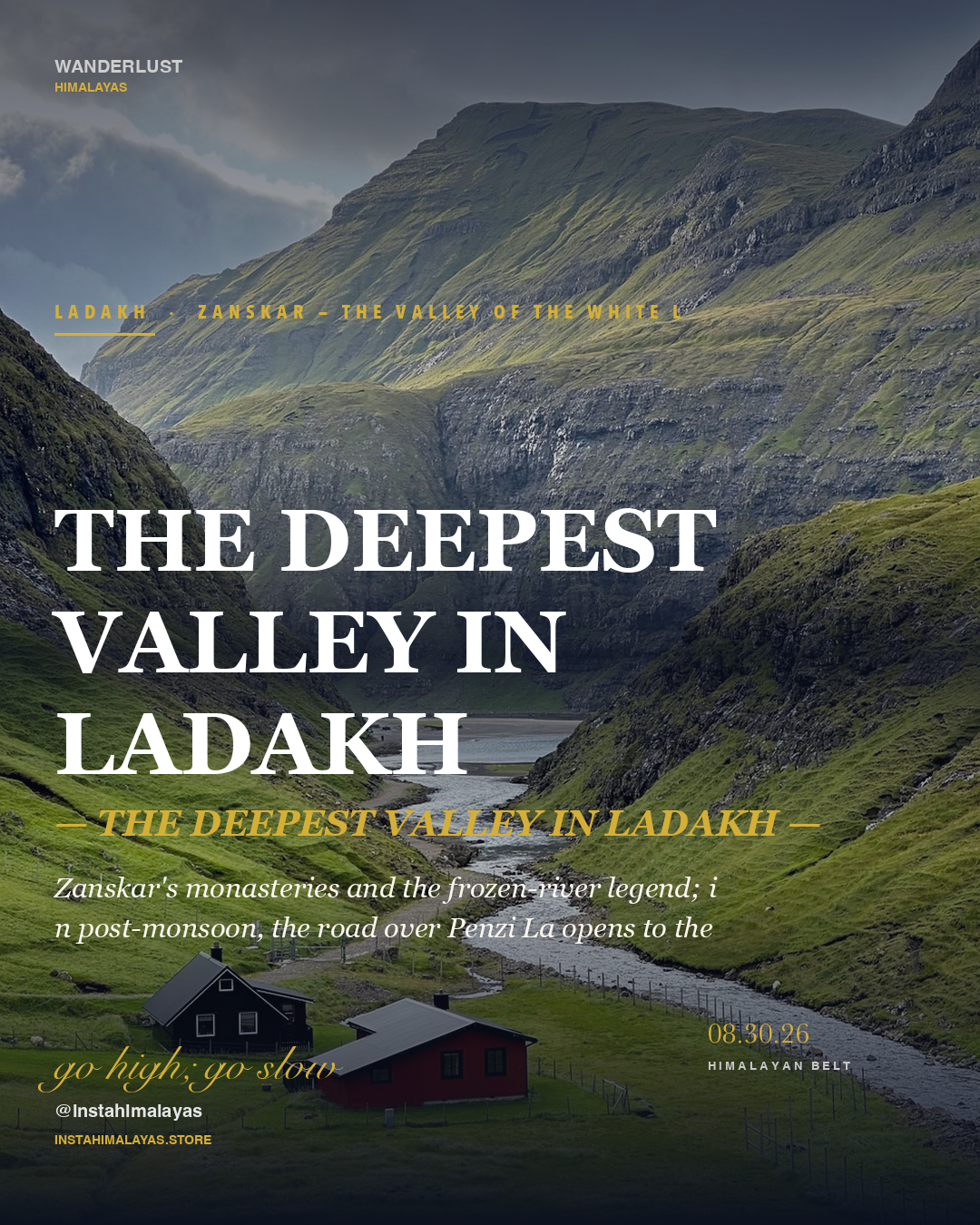
There is a road in the Western Himalaya that appears on maps as a single confident line between Manali and Leh, and disappears from every map the moment you ask what is actually on it. The answer: nothing, for most of the way. No villages above Rohtang. No settlements between Pang and the descent into the Indus Valley. Just tarmac, sky, and the long arithmetic of altitude.
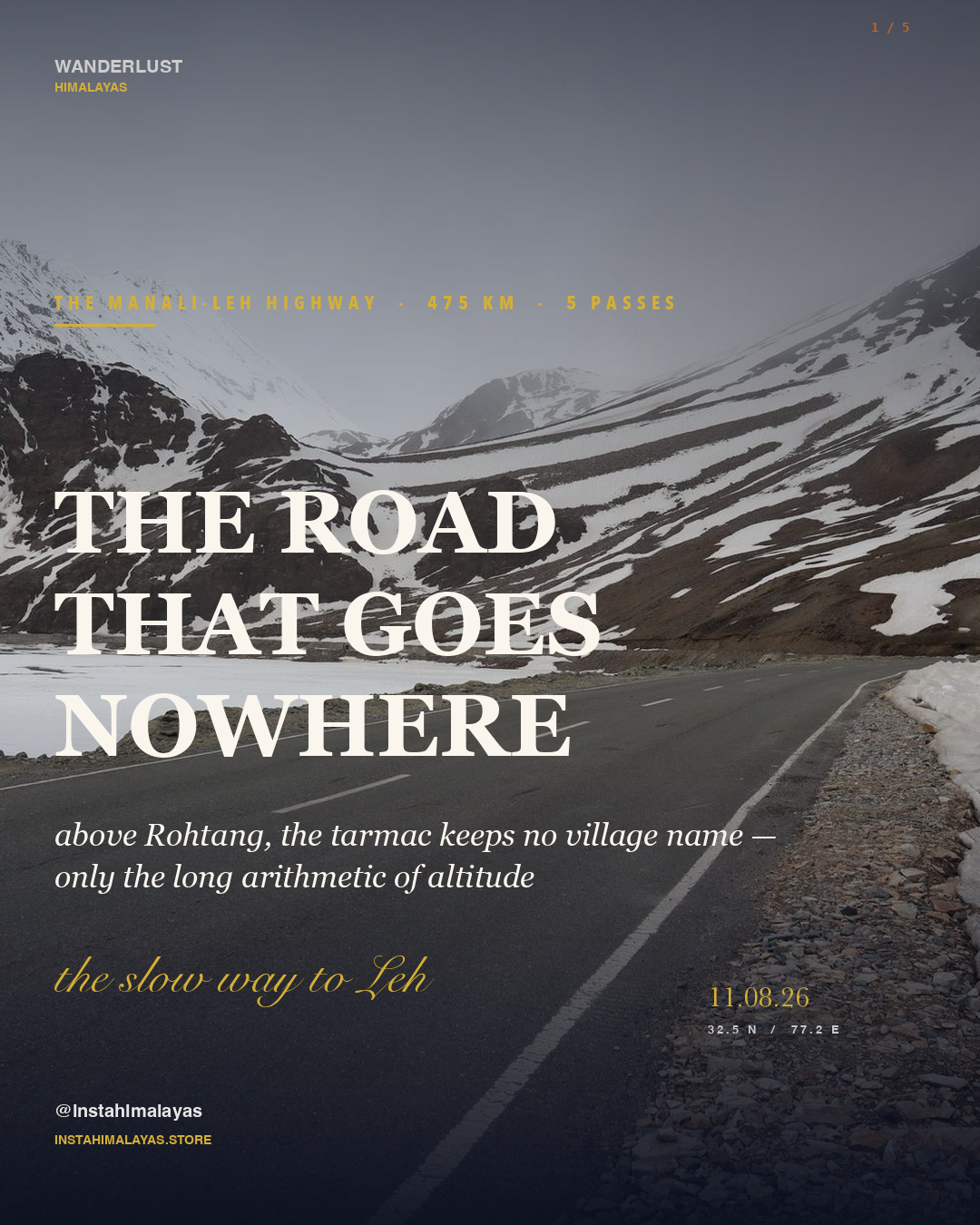
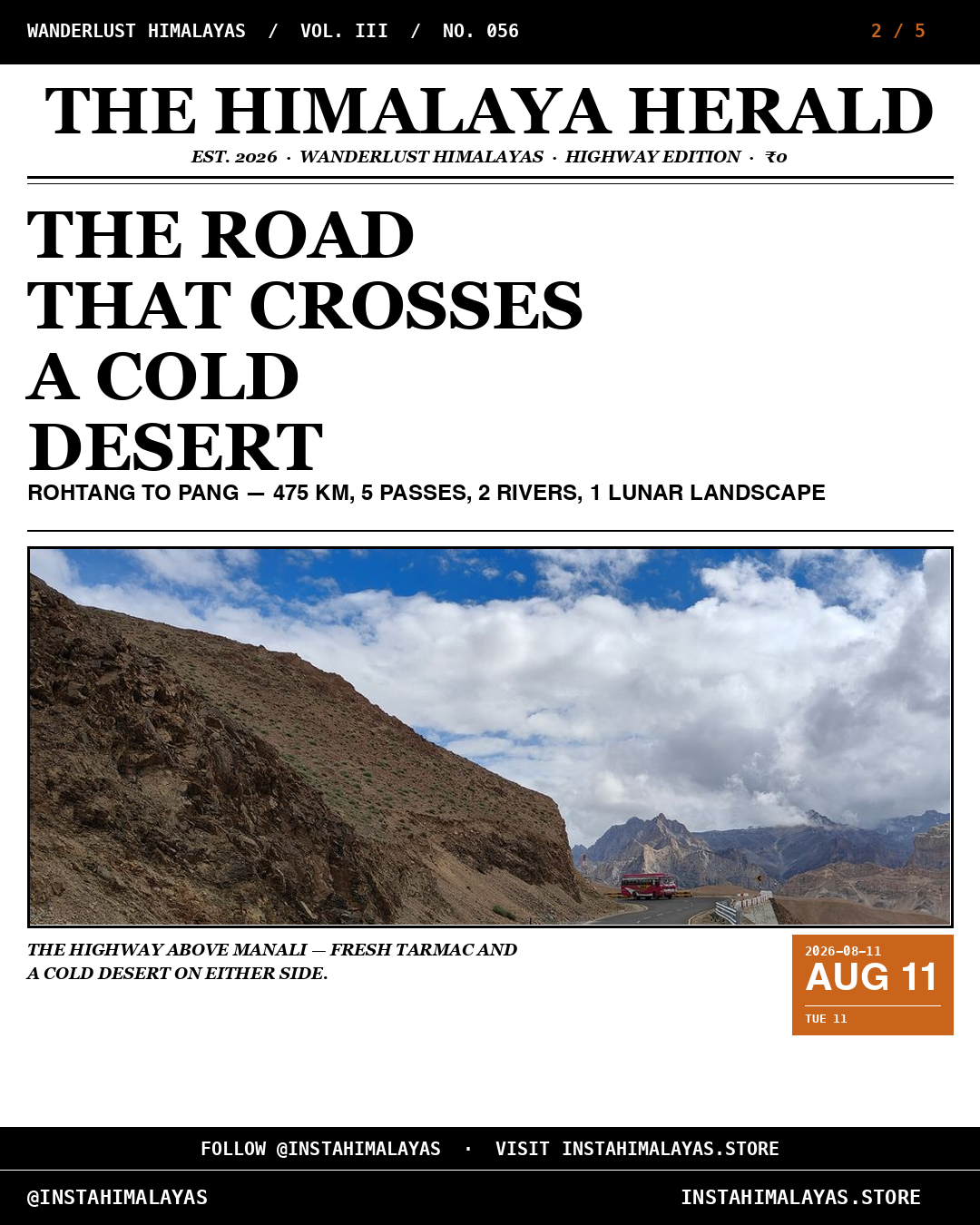
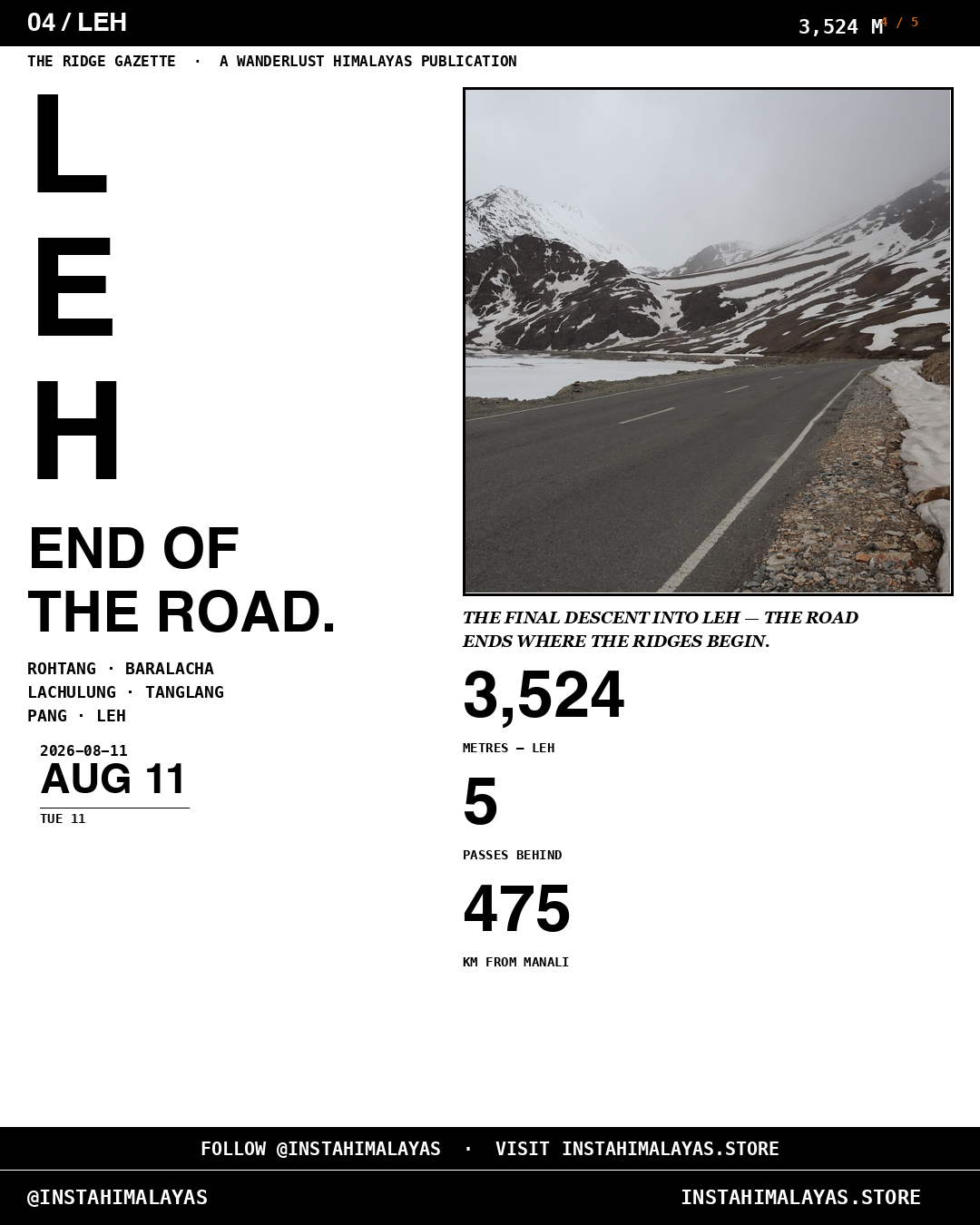
The Manali–Leh highway is 475 kilometres of National Highway 3, and it crosses five passes — Rohtang, Baralacha La, Lachulung La, Tanglang La, and Nakee La — on its way from the Kullu Valley to the Indus. It was built over decades by the Border Roads Organisation, and it still behaves like a construction site with a view: every kilometre is a small argument between a bulldozer and a mountain.
We drove it the way the road asks you to: slowly. This is the field guide we wished we had before we started.
The shape of the journey
The road divides naturally into three movements:
- Manali to Keylong — climbing out of the green Kullu Valley, over Rohtang Pass (3,978 m), down into the arid Lahaul Valley. Green becomes brown in a single hour.
- Keylong to Pang — the high plateau section. Baralacha La (4,890 m), then the wide, empty Morey Plains, then Pang at 4,600 m with its famous dhaba.
- Pang to Leh — over Lachulung La and Tanglang La (5,328 m), then the long descent to the Indus and the green oasis of Leh.
Pass by pass
Rohtang Pass (3,978 m) is the gate. It is crowded in season, and it does not care. Above it, the road is carved into the side of a mountain that has been falling down since before the road existed. The climb from Manali is green; the descent to Keylong is desert. In a single hour, you watch the Himalaya change its climate.
Baralacha La (4,890 m) is where the Chandra and Bhaga rivers are born. They emerge from the same glacier on opposite sides of the pass and eventually reunite as the Chenab, which is a fact of geography that sounds like a moral. The pass itself is a wide, wind-battered saddle, and the tea stall at the top is one of the great institutions of the highway.
Lachulung La (5,059 m) is short and sharp. The road climbs fast, the views open fast, and by the time you have registered the altitude, you are over the top and looking at the Morey Plains — a flat, treeless, utterly silent stretch of gravel and sky that is the closest most people will ever get to another planet.
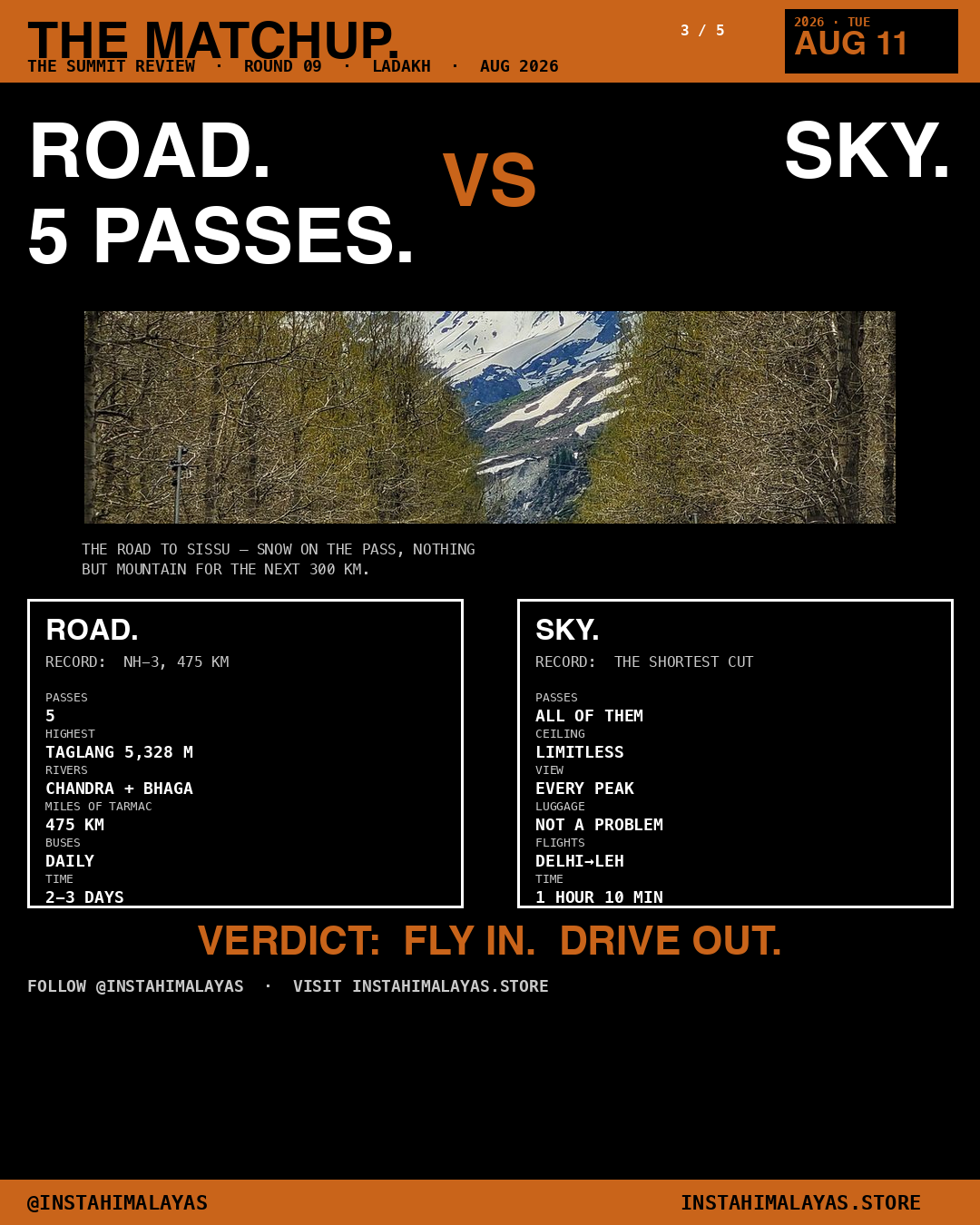
Tanglang La (5,328 m) is the second-highest motorable pass on Earth. The summit is a wide plateau with prayer flags, and the descent is forty kilometres of switchbacks down to the Indus Valley. The sensation at the top is not drama; it is stillness. You are above everything, and everything is quiet.
Nakee La (4,739 m) is the last one, and it is the easiest. After Tanglang, it feels like a speed bump. It is the highway's way of saying: you have done the hard part.
The practical rules
The road is open roughly June to October, and even then the weather is the real gatekeeper. A few rules we learned the hard way:
- Acclimatise before you climb. Spend a night in Manali or Keylong before Baralacha. Altitude sickness on the Morey Plains is not theoretical — it is the most common reason trips get cut short.
- Take two or three days, not one. The classic mistake is trying to do Manali to Leh in a single push. The road is 475 km of high passes; splitting it at Keylong and Pang makes it safe and enjoyable.
- The dhabas are the landmarks. The tea stalls at Baralacha, Pang and Rumtse are not just food stops — they are weather reports, social hubs and survival infrastructure. Talk to the people running them.
- Carry cash and warm layers. There are no ATMs above Keylong, and the temperature can drop below freezing at the passes even in August.
- Let the Border Roads convoys pass. The road is one lane in places and the BRO trucks have a schedule. Pull over, let them go, and enjoy the view while you wait.
The verdict
The flight from Delhi to Leh takes one hour and ten minutes. It is efficient, comfortable, and utterly forgettable. The road takes two to three days, and it will stay with you for years. It is not the fastest way to Leh. It is the only way that remembers you.
The highway does not go anywhere — that is exactly why you should take it.